
Diplomacy Lab Exhibitions
Hamhung

What do the North Koreans believe?
Ideology of Juche
Juche roughly means “self-reliance”, although it can also mean “subject”. The word itself tells in many ways the story of North Korea. Although it does originate with early translations of German philosophical writings, particularly Marxism, however, it appeared in the Korean lexicon through Japanese influence during the age of the Empire. In many ways, the ideology that came to be associated with the term is a product of the Korean War and the rise of the Kim dynasty, which holds complete Soviet-style totalitarian state control over the entire population. The North Korean government utilizes its education system as a tool for ideological indoctrination and control of the masses from an early age, particularly in developing the Juche ideology, which emphasizes obedience to the Kim family and justifies isolationism through the gaze of self-reliance and personal responsibility. Although it is presented as a path of self-reliance, Juche is a combination of self-blame and cult-like obedience to the Kim family.

The myth of self -reliance
Agriculture
The Arduous March
North Korea's stunted agricultural system and how it lead to the Arduous March
(info section in the works)

Image Source:
David Guttenfelder
AP/National Geographic
Poppy Flower: Poppy Seed
Poppy Seed originated in the Mediterranean region, it served as a sedative dating as far back as 2700 BC. One million poppy seeds amount to just one pound in weight , up to 168 pounds of poppy seeds are produced every year. Poppy seeds come from the poppy flower plant. The structure of the poppy flower consists of “the hen” which is a large central pod that is surrounded by various smaller pods. Once the poppy flower’s petals have all fallen off the pods will dry up. The dried pods can then be cut open to release dozens of poppy seeds. Poppy seeds serve various purposes, culinary being one of them. Poppy seeds can be pressed into oil, and are immensely popular for baking purposes in Middle Eastern, European and even North American cuisines. Poppy Seeds also possess nutritional benefits such as being rich in fiber and they also contain omega 6 fatty acids, manganese, folate, calcium and more. Poppyseeds are also utilized in herbal teas to ease levels of anxiety.

"North Korea's Drug of Choice"
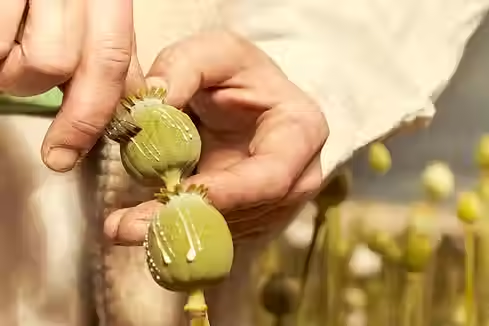
Poppy seeds can also be used in methods of opium cultivation. Opinions poppies will flower after 90 days of growth, and will keep flowering for up to 3 weeks. The petals will then last 4 days before dropping, revealing green seed pods which then mature to the size of an egg. This is the portion of the plant that can produce opium alkaloids. The North Korean government uses the opium poppy to make profit from the production of the addictive drug. Which is then smuggled across borders by North Korean diplomats. The labor of opium cultivation is often done by rural farm workers.
Cutting poppy heads with knife to harvest opium latex. (Adobe Stock) (Photo: RFA) (source- Radio Free Asia)
Opium Trade
North Korea started organizing its opium trade in the 1970s, when the Kim regime initiated covert state-sponsored poppy cultivation to generate hard cash. Farms in rural areas produced milk, which was processed into opium and heroin, which were trafficked across borders into Japan, China, and Russia. Opium trade quickly became a highly effective way to funnel funds into the country, which was orchestrated with the direct support of the state.
Diplomats from the DPRK and foreign service officials are directly involved in the drug trade. Numerous cases in the 1980s and 1990s involved diplomatic personnel arrested for heroin smuggling in Europe, the Middle East, and Asia. These instances were not isolated incidents, but part of a larger, organized strategy directed by the regime.
One of the most vital institutions in North Korea’s opium trade is the secretive “ Office 39”, a bureau within the Workers’ Party tasked with acquiring hard cash for the ruling class. Office 39 oversees drug production and trafficking operations, along with a portfolio of illicit enterprises including counterfeiting and arms sales. It coordinates with foreign partners and utilizes diplomatic channels to move narcotics discreetly across borders.
The rural population grew dependent on both the funds that opium provided as well as the chemical substance itself. While experiencing starvation and harsh conditions, many villagers became independent growers, creating another layer of a hidden drug economy.
Citations:
https://www.hrnk.org/wp-content/uploads/2024/07/SCG-FINAL-FINAL1.pdf
https://time.com/5829508/kim-yo-jong-money-office-39/
https://www.ojp.gov/pdffiles1/Digitization/141189NCJRS.pdf
https://www.armyupress.army.mil/Portals/7/Hot%20Spots/Documents/North-Korea/Hurst-North-Korea.pdf